
Categories

How to Win an Architecture Competition: 7 Tips for Students & Young Architects

Architecture competitions can be exciting, challenging and sometimes also overwhelming. While there is no guaranteed formula for first place, understanding the brief, researching deeply, developing a clear concept and presenting it well can significantly strengthen your entry.

Platforms such as the AIS Design Olympiad (ADO) give architecture students an opportunity to explore real-world design challenges while engaging with architects and industry professionals.

If you’re wondering how to win an architecture competition, we have compiled a few architecture competition tips for students, covering seven practical areas, from research and sustainability to presentation and final review. These tips can help you submit a thoughtful and memorable design.

How Can Students Increase Their Chances of Winning an Architecture Competition?

1. Read the Brief Like a Designer, Not Just a Participant

Before sketching your first idea, understand exactly what the architecture design competition wants.

Read the brief several times and identify the design objective, site restrictions, user requirements, judging criteria, mandatory deliverables and submission rules. Your design may look impressive, but it will struggle if it doesn’t address the actual problem.

Create a simple checklist from the brief, and refer to it throughout the design process.

2. Research the Site, Context and People Who Will Use It

Good architecture responds to its surroundings. Study the site’s climate, orientation, landscape, local culture, movement patterns, surrounding structures and social context.

Most importantly, think about the people who will actually use the space. What do they need? What problems should the design solve? Let site and user research influence your decisions rather than simply appearing as information on a presentation board.

3. Build One Strong and Original Design Concept

One of the most useful tips to win an architecture competition is to have a concept that you can explain in simple words.

Avoid adding ideas just to make the project appear innovative. Instead, identify one strong design thought and develop the planning, form, circulation, materials and experience around it.

Be bold, but keep the proposal functional and believable. Competition guidance also emphasises pushing creative boundaries without ignoring the rules.

4. Make Sustainability Part of the Design

Sustainability works best when it shapes the project from the beginning rather than being added as a final feature.

Consider daylight, ventilation, shading, energy use, water management, appropriate materials, accessibility and long-term usability. Showcase how the building will perform for its users and respond to local climatic conditions.

A convincing entry should show not only what the design looks like but also how and why it works.

5. Make Your Presentation Tell the Story Quickly

Judges may have numerous entries to review, so clarity matters. Strong presentation boards help them understand the central idea quickly.

Use plans, sections, diagrams, sketches, renders and short annotations only where they add value. Establish a clear visual hierarchy so the eye naturally moves from the main concept to supporting information.

Avoid filling every available space. A clean board with a strong design narrative is often easier to understand than one overloaded with drawings and text.

6. Study Successful Entries Without Copying Them

Looking at previous winners can help you understand what makes an architecture competition entry effective.

Observe how successful projects communicate their concepts, organise drawings, respond to the brief and balance creativity with practicality. Studying previous results and jury comments can reveal what evaluators considered particularly strong.

Use these observations to improve your approach, not to imitate another designer’s style.

7. Review, Refine and Check Every Submission Detail

Do not treat the first completed version as the final one.

Ask professors, peers, mentors or fellow architects to review your entry with fresh eyes. Check drawings, dimensions, spelling, labels, file sizes, formats, naming conventions and every submission requirement.

Most importantly, finish early enough to make corrections and increase your chances of being of the winning projects. A strong project should never be weakened by an avoidable technical mistake.

What Are Some Common Architecture Competition Mistakes to Avoid?

  • Misunderstanding or drifting away from the brief or the design resources
  • Developing an attractive but weak concept
  • Adding too much information to presentation boards
  • Ignoring functionality or site context
  • Missing file, format, or submission requirements
  • Leaving rendering and final checks until the last minute
  • Not adding all required details regarding your planned architecture and design project in the final submission

Conclusion – Architecture Competition Tips to Put into Practice with AIS Design Olympiad

Knowing how to win architecture competition entries is not about finding a shortcut. It is about researching better, designing with purpose, communicating clearly and continuously refining your thinking.

The AIS Design Olympiad gives architecture students a platform to tackle contemporary architectural challenges and present bold ideas to experienced professionals. As a top glass company in India, AIS also encourages students to explore design narratives, gain exposure, interact with the architecture and design community and build valuable professional connections. 

Ready to put your ideas into action? Register for ADO – AIS Design Olympiad and showcase your vision for the future of architecture.


    Categories

    Architecture Competition Types, Formats & How They Work Explained

    An architectural competition invites participants to respond to a design brief and submit proposals for expert evaluation. Competitions may be open or invitation-only, conceptual or project-based and organised in one or more stages.

    Understanding the format, eligibility rules and evaluation process helps participants choose suitable opportunities and prepare stronger entries.

    Architecture competitions explore fresh design ideas, solve architectural challenges and identify innovative proposals. For students and young architects, they offer practical exposure, portfolio value, expert feedback, industry recognition and a chance to test design thinking beyond the classroom.

    Understanding the major architectural competition types is therefore useful before deciding where to participate.

    What Is an Architectural Competition and How Is It Structured?

    An architectural competition is a structured process in which individuals or teams develop design proposals in response to a defined brief. The organiser typically provides the design problem, eligibility rules, site information, submission requirements, deadline, evaluation criteria and prizes.

    Participants research the challenge, develop a concept, prepare drawings or presentations, and submit their work for jury evaluation. Depending on the format, participants may include students, registered architects, firms or multidisciplinary teams.

    Student platforms such as the AIS Design Olympiad (ADO) give young designers a chance to work on future-focused challenges and present their ideas to experienced industry professionals. Refer to our how to win an architecture competition guide for more insights.

    What Are the Main Types of Architectural Competitions? 

    OpenLimited or invitedStudent ArchitectureIdeas and ConceptProject-BasedOne- or Two-Stage
    Open ForEveryoneSelected groupDesign studentsEveryoneArchitecture projectsDesign students
    PurposeAttract a wide range of ideasBuild experiencePortfolio building and exposureDesign possibilitiesDesign solutions for specific projectsProper competition for proposals and final project
    OutcomeExposure and LearningDeeper experience and LearningDesign enhancement and reviewDesign possibilities for a projectProject approvalConceptual learning
    • Open Competitions

    Open competitions are publicly announced and allow anyone meeting the stated eligibility conditions to participate. They can attract a wide range of ideas.

    • Limited or Invited Competitions

    These invite a selected group of architects, firms, or teams, usually when organisers want participants with particular experience or expertise.

    • Student Architecture Competitions

    These are created for architecture or design students, with emphasis on learning, experimentation, portfolio building and exposure.

    ADO falls within this category. It is an open, student-focused architecture and design competition for eligible students across India. It is best understood as a student concept/design competition and follows three rounds: online submission, regional evaluation and a final round.

    • Ideas and Concept Competitions

    Ideas competitions encourage participants to explore possibilities or rethink a design problem. The winning concept may not necessarily be developed into a real project.

    • Project-Based Competitions

    Project competitions address an actual architectural project. Their purpose is generally to identify a suitable design solution, and professional formats may lead to the winning architect being appointed for the project.

    • One-Stage and Two-Stage Competitions

    In a one-stage competition, participants submit their main proposals for one round of judging. In a two-stage competition, judges assess broader concepts first, after which shortlisted participants develop more detailed proposals.

    How Do Architectural Competitions Work? A Step-by-Step Process

    Understanding how does an architectural competition work can help participants prepare their entries more effectively. The process generally moves through three stages: pre-submission, submission and post-submission. While the exact process may vary by competition, these stages provide a general overview of how architectural competition work.

    Pre-Submission

    • Competition Announcement and Brief: The organiser publishes the challenge, site information, eligibility, timeline, deliverables and judging criteria.
    • Registration and Eligibility: Participants register individually or in teams and confirm that they meet the required criteria.

    Submission

    • Site and Design Research: Participants study the context, users, climate, circulation, materials, and other relevant factors.
    • Concept Development: Teams explore possible approaches and select an idea that responds well to the brief.
    • Proposal Development: Teams translate the concept into plans, sections, elevations, diagrams, renders, sustainability strategies or technical details.
    • Submission: Entries must follow the specified format, file size, anonymity rules and deadline.

    Post-Submission

    • Jury Evaluation: Judges assess proposals against the published criteria. Some competitions use anonymous evaluation to support fairness.
    • Shortlisting and Final Rounds: In multi-stage formats, shortlisted teams may refine their proposals or present before the jury.
    • Results and Recognition: Winners and special mentions are announced. Recognition may include prizes, publication, exhibitions, mentoring, scholarships or professional opportunities.

    What Do Judges Look for in Architecture Competition Entries?

    Judges generally look for a balance between creativity and a convincing response to the brief. Important factors include:

    • Design Concept and Creativity: A clear, original and relevant idea.
    • Response to the Brief and Site: Sensitivity to context, users and requirements.
    • Functionality: Spaces that work effectively for their intended purpose.
    • Sustainability: Thoughtful use of climate-responsive strategies, energy, materials and resources.
    • Technical Feasibility: A proposal that can be realistically developed.
    • Presentation Quality: Clear drawings, diagrams, renders and explanations.

    Conclusion

    The major types of architectural competition include open, limited, student, ideas, project-based, one-stage and multi-stage formats. Each comes with different expectations.

    Before entering, study the eligibility criteria, brief, deliverables, judging process and number of rounds. Understanding how architectural competitions work will help you choose the right opportunity and develop a stronger, more focused submission.

    Ready to put your ideas into action? Register for ADO – AIS Design Olympiad and showcase your vision for the future of architecture with AIS, a best glass company in India.

      Categories

      Architecture Competitions: A Complete Guide for Students and Young Architects

      Architecture competitions let students test their ideas beyond studio assignments. This guide explains why these contests matter, what formats to explore, where to find credible opportunities, how to choose one and how to create and submit a strong entry.

      Architecture school teaches design thinking, technical skills and presentation. Competitions add another layer by giving students a focused brief, a deadline and often an expert jury. This makes them a practical way to gain exposure while still studying.

      Participating in architecture and design competitions can strengthen a portfolio, encourage experimentation and create opportunities for recognition and networking.

      Platforms such as the AIS Design Olympiad (ADO) help bridge academic learning and real-world architectural challenges while giving students opportunities to interact with experienced architects and industry professionals.

      Why Architecture Competitions Can Give Students an Edge

      A good architecture student contest can support professional growth in several ways:

      • Portfolio Development: A strong competition project can show how you approach a brief from concept to presentation.
      • Creative Exploration: Students can test ideas beyond regular academic projects.
      • Recognition and Awards: Shortlisting or winning can add credibility to a student profile.
      • Industry Exposure: Jury reviews and events may connect students with practising architects and design professionals.
      • Collaboration and Networking: Team competitions build communication and shared problem-solving skills.
      • Real-world Thinking: Many briefs address sustainability, housing, public spaces, urban challenges or future-focused design.

      What Kinds of Architecture Competitions Can Students Enter?

      Architecture design competitions for students can include concept and ideas competitions, site-design challenges, rendering contests, sustainability-focused briefs, thesis awards and architecture writing competitions. Some are individual, while others require teams, and there are both free and paid-entry contests.

      Students should choose a competition based on their interests, skills, eligibility and portfolio goals. For more details on the different types and formats, refer to our architecture competition types guide.

      Where Can Students Find Credible Architecture Competitions?

      • Architecture schools and universities often circulate competitions through faculty members, notice boards and student networks.
      • Dedicated platforms are also useful. Competitions.archi publishes architecture competition listings, while ArchDaily maintains dedicated competition and student-competition sections.
      • Students looking for architecture competitions in India can also follow the Council of Architecture’s student awards, competitions and new initiatives.
      • The AIS Design Olympiad, or ADO, is a student-focused architecture and design competition. Our current ADO 8.0 edition is open to eligible 3rd- to 5th-year architecture students, follows a team format and has no registration fee – Register for ADO 8.0.
      • Social media pages, architecture communities and professional organisations can also help students discover calls for entries. Always verify the details on the organiser’s official page before registering.

      For more guidance on how to find and participate in architecture competitions, refer to our detailed guide. 

      How to Choose an Architecture Competition That Suits You

      Before choosing any competition for architecture students, check the eligibility rules, theme, design brief, deadlines, entry fee, team requirements, judging criteria, awards and expected deliverables.

      The right competition is not necessarily the biggest one. It should suit your strengths, interests and the amount of time you can realistically commit.

      Typically, based on what you want to gain, you can pick a competition.

      • If you want to build your portfolio, go for student architecture competitions
      • If you want to win recognition, go for project-based competitions
      • If you want to experiment with your design possibilities, go for idea- and concept-oriented competitions
      • If you want to learn without paying an upfront fee, go for open competitions
      • If you want to gain industry exposure, go for limited or invite-only competitions

      How to Go From Registration to Final Submission

      1. Start by reading the competition brief carefully. Note every requirement, from site conditions and deliverables to file formats and board sizes.
      2. Next, research the site, user needs and design problems. Use this understanding to develop a clear concept instead of jumping straight into form-making.
      3. Refine the idea through sketches, models, diagrams and feedback. Then prepare the final submission with the required drawings, plans, sections, renders and explanatory text.
      4. Before submitting, review the rules again. Check naming conventions, anonymity requirements, file size, resolution, deadlines and upload instructions. Even a strong idea can be rejected if the submission format is incorrect.

      Tips to Make Your Architecture Competition Entry Stand Out

      • Keep the central idea easy to understand.
      • Make the design creative, but also show how it responds to its context.
      • Use visuals that support the concept instead of overcrowding the presentation boards.
      • Consider sustainability, climate, users and materials where relevant.
      • Most importantly, follow every submission requirement exactly.

      For more practical guidance, refer to our tips for winning an architecture competition. 

      Conclusion – Turn Architecture Competitions Into Learning Opportunities

      Architectural competitions in India for students can turn classroom learning into valuable design experience. They help students practise problem-solving, strengthen portfolios and gain exposure to the wider architecture community.

      At AIS, we see student competitions as an important way to encourage the next generation of designers. As a leading integrated glass and window solutions company and a top glass manufacturer and supplier in India, we created the AIS Design Olympiad.

      This competition gives architecture students a platform to explore future-focused ideas, interact with industry professionals and present their work beyond the classroom.

      Frequently Asked Questions

      1. What are architecture competitions for students?

      Architecture competitions for students are design challenges that allow architecture students to develop and present solutions to a defined brief, often evaluated by a professional jury.

      2. Are architecture competitions useful for architecture students?

      Yes. They can help students develop portfolio projects, experiment with ideas outside studio work, practise presenting design concepts and gain exposure to architects and industry professionals.

      3. Are there free architecture competitions for students?

      Yes. Some student competitions have no registration fee, while others charge an entry fee. Students should always check the official competition rules before registering.

      4. Can first-year architecture students participate?

      Eligibility varies by competition. Some are open to all architecture students, while others specify a year of study or other eligibility requirements.

      5. Do architecture competitions help build a portfolio?

      Yes. A well-developed competition project can demonstrate conceptual thinking, research, design development and presentation skills.

        Categories

        Architecture Competitions for Students: How to Find & Participate in Design Contests

        Architecture competitions give students and young architects a chance to solve design challenges, test ideas, strengthen portfolios and gain industry exposure. This guide explains what an architectural competition in India is, why it matters, where to find opportunities and how to prepare a strong entry.

        For students and young professionals, competitions can extend learning beyond studio assignments. They expose participants to unfamiliar briefs, real or imagined sites, fixed deadlines and judging criteria. In the process, young designers learn to research, develop concepts, communicate ideas visually and justify decisions.

        What Is an Architecture Competition?

        An architecture competition is a structured contest in which participants respond to a design brief and submit proposals for a jury to evaluate. Unlike a regular academic or client project, an architectural competition often gives participants more room to experiment with new concepts, technology, sustainability and spatial ideas.

        Eligibility varies. Some competitions are only for students, while others welcome graduates, young architects, established professionals or firms.

        The AIS Design Olympiad (ADO) is one such Indian initiative. Conducted by AIS, one of the best glass companies in India, it connects academic learning with real-world architectural challenges and gives students an opportunity to learn from architects and industry professionals.

        Why Should Students and Young Architects Participate?

        Architecture and design competitions can offer several benefits:

        • Build a stronger portfolio: Add independent, concept-driven work beyond routine academic projects.
        • Develop design skills: Practise creative problem-solving within a defined brief and deadline.
        • Gain practical exposure: Work with issues related to users, sites, climate, materials or emerging design needs.
        • Earn recognition: Winning or shortlisted entries may lead to awards, publication or industry visibility.
        • Grow your network: Interact with architects, jurors, designers and other participants.
        • Explore specialisations: Experiment with areas such as sustainable architecture, housing, urban design or smart buildings.

        Even without winning, the process can help you understand your strengths and improve how you present design ideas.

        What Types of Architecture Design Competitions Can You Enter?

        Common options include student architecture competitions, open competitions, ideas and concept competitions, project-based contests and national or international competitions.

        Some focus on speculative thinking, while others are based on actual sites or practical design problems. Choose a format that matches your experience and portfolio goals.

        Where Can You Find Architecture Competitions?

        Architecture schools, universities, professional bodies, design institutions and architecture firms are good places to start. Online platforms such as ArchDaily and Competitions.archi also publish calls for architecture design competitions across different themes and regions.

        Students searching for an architecture design competition in India can also follow initiatives such as the AIS Design Olympiad, along with architecture publications, college networks, professional associations and credible design communities.

        Always check the official competition page before registering to confirm the latest brief, eligibility criteria and submission rules.

        How to Choose the Right Architecture Competition

        • Before entering, review the eligibility requirements, theme, design brief, deadline and registration fee.
        • Check whether participation is individual or team-based, what deliverables are required and how entries will be judged.
        • Look beyond prize money. Publication, exhibitions, mentorship, jury feedback and industry exposure can be equally useful.
        • Choose a competition that supports your interests, skill level and long-term career goals.

        How to Participate in an Architecture Competition

        • Start by reading the brief carefully and identifying the central design problem.
        • Research the site, users, climate and context before developing your concept.
        • Then translate the idea into clear plans, diagrams, drawings, renders and concise supporting text.
        • Before submission, check the required file format, sheet dimensions, naming rules, anonymity requirements and deadline.

        Tips to Create a Strong Architecture Competition Entry

        • Keep the central idea clear and make every drawing or diagram support it.
        • Respond directly to the brief instead of adding unnecessary complexity.
        • Balance creativity with function, context and feasibility.
        • Use a clean visual hierarchy, readable graphics and concise explanations so that the jury can understand the proposal quickly.

        Conclusion – How Can Architecture Competitions Help Build Your Career?

        A strong architecture competition can strengthen your portfolio, demonstrate independent design thinking, add recognition to your CV and build valuable professional connections.

        AIS continues to encourage emerging architectural talent through Register for ADO 8.0, the eighth edition of the AIS Design Olympiad. The 2026-27 edition centres on “Mixed Use Buildings for Future Extremes” and challenges students to imagine climate-resilient, adaptive and human-centred architecture for 2050.

        For students and young architects, the right architecture competition can be both a creative challenge and a meaningful step towards building a stronger professional identity.

          Categories

          How to Prevent & Remove Water Stains on Glass During Monsoon

          Monsoon rain can quickly make glass windows, doors and façades look dull. Water droplets dry on the surface, while dust and dirt stick to wet glass and leave visible marks. Hard water splashes can also leave mineral deposits behind.

          Regular cleaning, proper drying and a few preventive steps can help you control water stains on glass throughout the rainy season.

          Why Does Glass Get Water Stains During Monsoon?

          • Mineral Deposits: Hard water contains minerals such as calcium and magnesium. When water evaporates, these can remain as cloudy deposits.
          • Dust and Dirt: Rain mixes with grime already present on windows and can leave marks after drying.
          • Prolonged Moisture: Glass that stays damp for long periods develops spotting and residue more easily.
          • Poor Water Runoff: Blocked drainage channels or dirty frames can allow water to collect around the glass.
          • Irregular Cleaning: Repeated wetting and drying can make old stains harder to remove.

          How To Remove Water Spots From Glass? Common Tips

          Most water spots on glass, regardless of the type, can be removed with the simple steps mentioned below. Common glass types like plain, solar glass, laminated glass, tempered glass and coated are also easy to maintain, as long as you use the right materials and clean them regularly.

          For instance, coated and tempered glass require daily wipe, whereas plain and laminated glass can be cleaned once every 2-3 days.

          1. Clean the Glass Regularly

          Do not wait for dirt to build up. Wipe exposed glass regularly with clean water and a soft microfibre cloth. This prevents dust, grime and mineral residue from settling on the surface.

          2. Use a Squeegee After Rain

          When safe and practical, use a clean rubber squeegee on accessible glass after heavy rain. Work from top to bottom. Removing water before it dries is one of the simplest ways to reduce spotting.

          3. Choose the Right Glass Cleaner

          Use a mild cleaner suitable for your glass surface. Avoid excessive chemicals, as leftover cleaner can cause streaks. If the glass has a special coating or treatment, follow the recommended care instructions.

          4. Keep Frames and Drainage Channels Clean

          Dirt, leaves and sludge often collect in window tracks and drainage openings during monsoon. Clear them regularly so rainwater can drain instead of pooling near the glass.

          5. Use a Compatible Water-Repellent Treatment

          A suitable water-repellent treatment can help water bead and run off more easily. However, check that the product is compatible with the glass type and any existing coating before application.

          DIY Tips To Remove Water Marks from Glass During Rainy Season

          Hard water stains on glass often feel challenging to clean. However, a few simple home remedies and regular cleaning can help you reduce the appearance and formation of hard water spots on glass.

          • Wipe the surface with clean water and a soft, lint-free or microfibre cloth.
          • Use a suitable glass cleaner for light marks.
          • For persistent mineral deposits, use an appropriate descaling product as directed. A mild vinegar-based solution may help on ordinary uncoated glass, but clean specialised or coated glass only according to its care instructions.
          • Rinse thoroughly with clean water.
          • Dry completely with a microfibre cloth or squeegee.

          When removing hard water stains from glass, avoid aggressive scrubbing. Rough pads, blades and abrasive powders can scratch the surface or damage certain coatings. This is especially important when learning how to get rid of hard water stains on glass safely.

          Common Glass-Cleaning Mistakes to Avoid During Monsoon

          • Letting rainwater repeatedly dry on the glass
          • Using steel wool, rough scrubbers or abrasive powders
          • Applying too much cleaning solution
          • Cleaning hot glass in direct sunlight, as the solution may dry too quickly and leave streaks
          • Ignoring stains for long periods
          • Allowing dirt and standing water to collect around frames

          How Often Should You Clean Glass During Monsoon?

          There is no fixed schedule for every property. Sheltered glass may only need routine cleaning, while windows exposed to heavy rain, road dust or construction activity may need more frequent attention.

          Inspect exposed glass regularly and wipe it down after heavy rainfall whenever practical and safe. Shower glass or other surfaces exposed to hard water may also benefit from quick drying after use.

          What Type of Stain Do You Have? Quick Cleaning Summary

          What you seeLikely causeRecommended approach
          Water spotsRainwater or water droplets drying on the glassWipe with a soft, damp microfibre cloth. You can also use a suitable glass cleaner for harsher spots.
          Dirt marksDust, dirt and grime mixing with rainwaterClean with a mixture of clean water and a mild glass cleaner. Don’t use abrasive scrubbers, as they can impact the glass finish.
          White depositsMineral deposits left behind as hard water evaporatesUse a mild mixture of water and glass cleaning solution. For coated or treated glass, follow the manufacturer’s cleaning instructions only.

          Conclusion – Keep Your Glass Clear Through the Monsoon

          Monsoon stains are easier to prevent than to remove after weeks of buildup. Regular wiping, proper drying, clear drainage channels and suitable cleaning products can go a long way in maintaining glass clarity.

          At AIS Glass, a leading glass company, we understand that the right glass also needs the right care. We offer a wide range of glass solutions across automotive, architectural and consumer applications.

          With simple monsoon maintenance, you can help keep your glass clean and clear through the rainy season and beyond.

            Categories

            6 Glass Railing Design Ideas for Modern Homes & Balconies

            A well-planned glass railing design can make a balcony, staircase or terrace feel brighter, more open and distinctly modern. Homeowners can choose from frameless, tinted, frosted, steel-framed, LED-lit and decorative glass styles depending on their privacy, safety and design needs.

            The key is to pair the preferred look with suitable safety glass, reliable hardware and professional installation.

            Why Glass Railings Work So Well in Modern Homes

            A few reasons to consider glass railings for balcony and staircase areas include:

            • Clearer Views: Transparent panels create fewer visual obstructions.
            • Contemporary Appeal: Glass works well with minimalist and modern architecture.
            • Safety Options: Toughened glass and laminated glass can be used for architectural applications. Both come under IS 2553 (Part 1):2018 for architectural, building and general uses.
            • Natural Light: Glass avoids blocking daylight unnecessarily.
            • Easy Upkeep: Smooth glass surfaces can generally be cleaned with a soft cloth and mild cleaning solution.
            • Design Flexibility: Clear, tinted, frosted and decorative finishes allow the railing to complement a range of home styles.

            6 Modern Glass Railing Ideas Worth Considering

            1. Frameless Glass Railings for an Uninterrupted View

            A frameless glass railing design for a balcony is ideal when the view is the highlight. With minimal visible framing, the balcony looks open and seamless.

            This style works particularly well for luxury apartments, villas, terraces and homes overlooking gardens or scenic surroundings. Select toughened or laminated safety glass based on the railing system and structural requirements.

            2. Tinted Glass for Style and Added Privacy

            Tinted glass adds colour and depth to a balcony without sacrificing the sleekness of glass. Grey, bronze and green are among the commonly available shades. AIS Tinted Glass, for example, is available in Dark Grey, Green and Bronze.

            Tinted glass can also reduce glare and solar heat gain, making this modern balcony glass railing idea useful in areas with strong sunlight.

            3. Frosted Glass for Private Balconies

            For apartments facing neighbouring buildings or busy streets, frosted glass offers a practical balance between privacy and daylight.

            Its translucent surface limits direct visibility while still allowing diffused light through. This makes it a useful balcony railing glass design for urban homes where complete transparency may not be desirable.

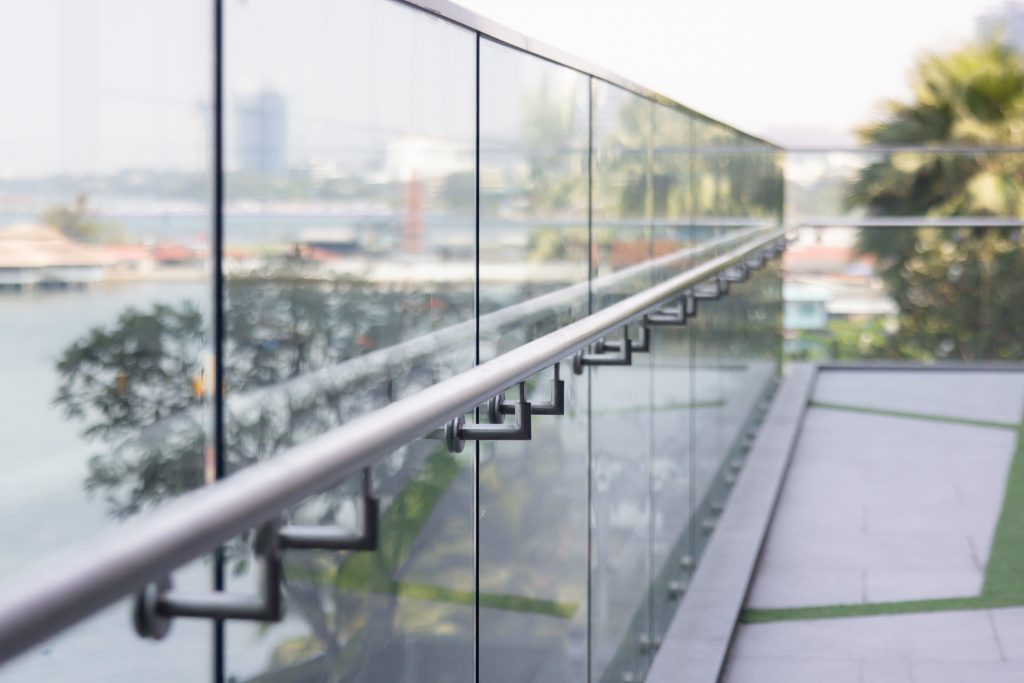
            4. Glass Railings with Stainless Steel Handrails

            Pairing transparent glass panels with stainless steel posts or handrails creates a clean, structured look.

            The metal gives the railing visual definition, while the glass keeps it from feeling heavy. For homeowners comparing different railings glass design options, this combination works well across balconies, staircases, duplex homes and terraces.

            5. LED-Lit Glass Railings for Evening Ambience

            LED lighting can transform a simple railing into a design feature after sunset. Lights can be incorporated along edges or suitable railing components to produce a soft glow.

            Apart from creating a premium atmosphere, integrated lighting can improve visibility around the edges of balconies and terraces at night. It is an appealing option for anyone seeking a modern-style glass railing design for a balcony used for evening seating or entertaining.

            6. Decorative or Fritted Glass for a Unique Look

            A balcony railing does not always need to be completely plain. Fritted, patterned or decorative glass can introduce geometric motifs, textures or subtle visual details.

            Patterned glass can also provide additional screening while keeping the overall design contemporary. Fritted glass combines decorative interest with greater privacy.

            How to Select the Right Glass for Balcony Railings?

            • Toughened Glass vs Laminated Glass: Toughened glass is processed to offer higher strength than standard glass, while laminated glass consists of multiple glass layers bonded with an interlayer that helps hold the glass together if it breaks. The choice between the two should be based on the railing system, safety requirements and structural specifications. For a detailed comparison, read tempered glass vs laminated glass to understand the key differences and choose the right glass for your needs.
            • Glass Thickness: Select the appropriate glass thickness based on the panel size, railing height, support system, expected loads and applicable safety requirements. Refer to our glass thickness guide for more details.
            • Clear vs Tinted vs Frosted Glass: Clear glass is ideal for uninterrupted views; tinted glass can provide greater visual comfort and privacy; and frosted glass is suitable where privacy is a priority without completely blocking natural light. Refer to our clear vs frosted glass guide for more details. 
            • Hardware Compatibility: The selected glass should be compatible with the brackets, clamps, channels, posts and handrails used in the railing system to ensure a secure, reliable installation.

            Glass Railing vs Other Railing Options: Quick Comparison

            FactorGlassSteel/AluminumWood
            VisibilityUnobstructedPartialLow
            DurabilityHigh, if maintained properlyHighHigh
            MaintenanceHigh, with regular cleaningLowHigh, to avoid damage
            Design FlexibilityLow to medium, depends on cut, frameless vs frame, finishes, etc.HighLow to medium
            SafetyHigh (with shattered resistant glass or tempered options)HighHigh

            Are Glass Railings Safe for Your Home?

            Yes, they are safe. In modern architecture, glass railings by AIS Glass today are engineered with safety glass options, including AIS Stronglas and security glass solutions. Both of them are specifically designed to offer highest safety for high-rise balconies, outdoor decks and staircases.

            Most of these glass types break into blunt pieces to reduce risk of injuries. Additionally, our glass types are 4 to 5 times stronger than standard glass and comprises two layers of toughened glass bonded with a Polyvinyl Butyral (PVB) or SentryGlas (SGP) interlayer.

            What to Check Before Installing a Glass Balcony Railing

            Before finalising any design, consider:

            • Balcony dimensions and layout
            • Required level of privacy
            • Applicable building and safety requirements
            • Exposure to wind, particularly in high-rise buildings
            • Compatibility between glass, brackets, channels and handrails
            • Ease of cleaning and maintenance
            • Overall project budget
            • Professional fabrication and installation

            Conclusion

            The right glass railing can make a balcony feel more spacious without compromising its architectural character. From clear and tinted options to frosted and decorative solutions, AIS offers a broad range of architectural glass products to meet diverse aesthetic and functional requirements.

            When choosing among the best glass manufacturers, consider factors such as glass quality, product range, safety standards and suitability for your railing application. Whether you prefer a minimalist frameless railing or a more decorative glass railing design, selecting the right glass and manufacturer is important for achieving the desired balance of safety, functionality and aesthetics.

              We use cookies to help you get the best possible experience of our site. By clicking 'Accept' you agree to our use of cookies.