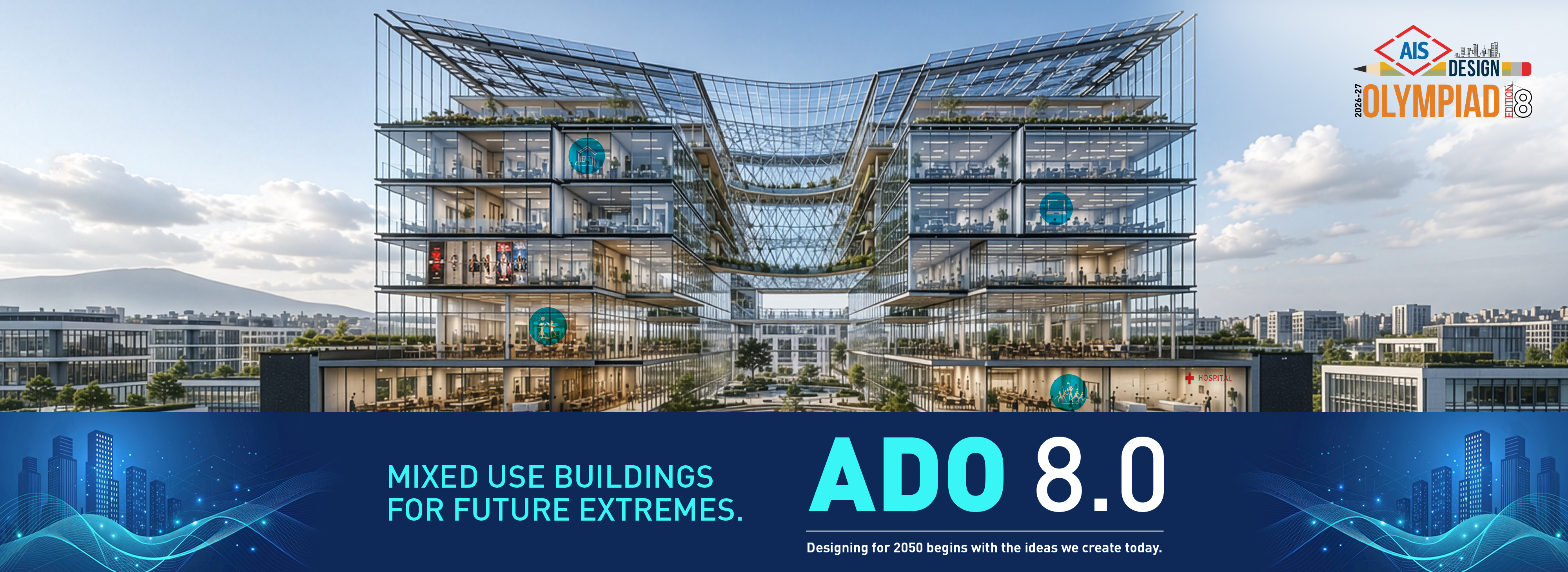
ADO 8.0 challenges architecture students to envision the next era of the built environment through resilient, adaptive, and human-centric design. Create future-ready mixed-use spaces where sustainability, intelligent systems, climate-responsive façades, and evolving human needs come together to shape architecture for 2050.
The built environment stands at the forefront of the climate crisis, contributing significantly to global emissions while simultaneously being vulnerable to its effects. By 2050, cities are expected to face rising temperatures, urban flooding, energy stress, and water scarcity, demanding a complete rethinking of how buildings are designed and operated. Conventional architectural approaches are no longer enough to respond to these evolving challenges.
ADO 8.0 encourages students to explore architecture as a resilient and intelligent ecosystem. The competition challenges participants to design future-ready mixed-use developments that integrate passive strategies, renewable energy systems, adaptive façades, AI-driven tools, and innovative materials to create sustainable environments that are functional, regenerative, and responsive to both people and planet.
This year’s theme pushes students to think beyond traditional solutions and embrace architecture that adapts, learns, and evolves with changing environmental and social conditions. From responsive building skins and smart glazing systems to AI-assisted design optimization and flexible community spaces, ADO 8.0 is an opportunity to redefine the future of architecture through innovation and responsibility.
 Mr. Vikram Khanna
"As a company closely associated with the evolving landscape of architecture and building solutions, AIS believes it is important to nurture conversations and ideas that will define the future of our cities.
Through ADO 8.0, we seek to encourage young architects to explore climate-responsive design, intelligent façades, energy-efficient systems, and material innovation in meaningful ways. The future demands solutions that are not only sustainable, but also adaptive, scalable, and deeply rooted in human experience.
More than just a competition, ADO 8.0 is a platform that encourages students to think big, push boundaries, and explore bold design narratives. It enables meaningful interaction with leading architects and industry professionals—offering an invaluable opportunity to showcase talent, gain critical exposure, and build a lasting network within the architecture and design fraternity. "

"The built environment of 2050 must do far more than provide shelter - it must actively contribute to resilience, sustainability, and community well-being. This year’s theme challenges participants to explore architecture as an interconnected system where environmental performance, social interaction, and technological innovation work together seamlessly. ADO continues to be a platform that encourages students to engage with future-facing ideas while remaining grounded in contextual and human-centric design."

"The architectural challenges of the future will not be solved through incremental change, but through bold, interdisciplinary thinking. ADO 8.0 is an invitation for students to rethink the role of architecture in a rapidly changing climate scenario - to imagine buildings that are responsive, regenerative, and technologically empowered. The integration of AI, adaptive systems, and climate intelligence into the design process has the potential to reshape the very language of architecture."
Asahi India Glass Ltd. (AIS) is India’s leading integrated glass and window solutions company and a dominant player across both the automotive and architectural glass segments. Since its starting in 1987, AIS has built a strong presence across the entire glass value chain, from manufacturing float glass to processing, fabrication, and installation.
AIS operates through three Strategic Business Units — Automotive, Architectural, and Consumer Glass — delivering innovative glass products and solutions to retail and institutional customers in both domestic and international markets. Through continuous innovation and technological advancement, AIS remains committed to enabling sustainable, high-performance, and future-ready architectural solutions.
Designing for 2050 begins with the ideas we create today.
Participants are invited to design a climate-resilient mixed-use building for 2050 that integrates passive design strategies, adaptive façades, renewable energy systems, and water-sensitive planning to create sustainable and future-ready environments. The objective is to envision architecture that balances environmental responsibility, technological innovation, human well-being, and functional flexibility through intelligent systems, AI-driven design approaches, and community-centric spaces within a cohesive architectural vision.
ADO 8.0 is a challenge to design beyond the present and imagine architecture for a rapidly evolving future. It is an opportunity to rethink buildings as intelligent ecosystems that respond to climate, technology, and human needs with resilience and adaptability.
As future architects and designers, participants are invited to create spaces that are regenerative, sustainable, and deeply connected to the well-being of people and the planet.
Design for Resilience. Design for Adaptation. Design for 2050.
AIS Design Olympiad (ADO) is a premier architecture and design competition for students, created to bridge the gap between academic learning and real-world architectural challenges. Organized by AIS, ADO provides aspiring architects with a unique platform to showcase their creativity, innovation, and problem-solving abilities while receiving guidance from leading industry experts and professionals.
Open to architecture students from the 3rd to 5th year, ADO encourages participants to explore emerging technologies, sustainable design strategies, advanced materials, and future-forward architectural solutions. The competition challenges students to think beyond conventional design approaches and create impactful spaces that address evolving environmental, social, and technological needs.
Now in its 8th edition, ADO 2026 invites students to envision architecture for 2050 through the theme “Mixed Use Buildings for Future Extreme.” Participants are challenged to create future-ready mixed-use developments that seamlessly integrate sustainability, climate-responsive façades, renewable energy systems, adaptive design, AI-assisted innovation, and human-centric spaces.
Through ADO 8.0, AIS aims to inspire the next generation of architects to design environments that are not only functional and aesthetically compelling but also regenerative, adaptable, and responsive to the needs of both people and the planet.
The AIS Design Olympiad (ADO) 8.0 for architecture students is open to all students across the country. It provides students with a stage to present their innovative ideas and solutions for the future of the built environment.
If you are a 3rd to 5th-year student in architecture, you can participate in this architecture competition. To ensure fair competition, the eligibility parameters that participating teams must meet at the time of AIS registration are provided below. Failure to meet these criteria may result in the rejection of your candidature.
India has various architecture and design competitions. However, ADO stands out for the unique opportunity it offers students to work with eminent professionals in architecture and design while exploring future-ready mixed-use developments that integrate sustainability, intelligent systems, climate-responsive design, adaptive façades, and human-centric spaces for 2050.
No, there is no registration fee to participate in the AIS Design Olympiad. The contest is entirely free of cost for all eligible students. AIS, through its architecture contest, offers all capable students an opportunity to showcase their creativity and talent.
By eliminating any registration cost, the competition encourages participation from students from far and across the Indian subcontinent. This allows students from all strata of society to participate, the only qualifying factor being their talent and creativity.
The registration process for this upcoming architectural competition is very simple. All you need to do is:
The winners of ADO 8.0 will receive a group prize of ₹1,00,000 along with an additional sponsorship of ₹1,00,000 towards college fees for each team member. The first runners-up will be awarded ₹50,000 as a group prize and ₹75,000 in sponsorship per team member, while the second runners-up will receive ₹30,000 as a group prize and ₹50,000 per team member towards college fees. A special prize of ₹30,000 will also be awarded.
Keeping registration free of cost, AIS has exemplified its commitment to nurturing young talent. This same vision is reflected in the theme of ADO 8.0.
With the theme focused on designing resilient and intelligent built environments for 2050, participants are challenged to create future-ready mixed-use developments that integrate sustainability, climate-responsive façades, adaptive design strategies, renewable energy systems, AI-driven innovation, and human-centric spaces. The competition encourages students to explore how architecture can become more responsive, regenerative, and adaptable to the evolving needs of people and the planet.
With no registration fees, students can focus solely on creating innovative solutions that demonstrate their talent, creativity, and vision for the future. This makes ADO not just an architecture contest, but an empowering opportunity for the next generation of architects and designers to shine on a national level.
Yes, you can participate as a team in the AIS Design Olympiad. Teams must consist of a minimum of 2 and a maximum of 4 members. This allows students to collaborate and combine their creative strengths. The competition is designed to bring out the best in individuals while promoting collaborative learning—an essential trait in the architecture and design industry.
Participating as a team in ADO 8.0 helps students develop the collaborative skills needed to solve real-world challenges. Designing resilient and intelligent built environments requires expertise from multiple disciplines, making teamwork a critical component of the design process. ADO provides a valuable platform where students can learn from one another, combine their strengths, and showcase their ideas on a national stage.
ADO 8.0 features a single competition theme that challenges students to envision the future of architecture through resilient, adaptive, and human-centric design. The objective is to create future-ready mixed-use developments where sustainability, intelligent systems, climate-responsive façades, and evolving human needs come together to shape architecture for 2050.
The primary goal of the competition is to encourage students to explore architecture as a resilient and intelligent ecosystem. Participants are expected to develop innovative design solutions that integrate passive design strategies, renewable energy systems, adaptive façades, AI-driven tools, and advanced materials to create sustainable environments that are functional, regenerative, and responsive to both people and the planet.
The task at hand for the students is to:
Design a future-ready mixed-use development that reimagines how people live, work, interact, and thrive in 2050. The proposal should demonstrate a strong commitment to sustainability, resilience, adaptability, and user well-being while incorporating intelligent building systems, climate-responsive design strategies, renewable energy integration, and flexible community spaces. Students are encouraged to explore how architecture can evolve to respond to changing environmental, technological, and social conditions.
By providing such a forward-looking theme, the AIS Design Olympiad inspires architecture students to devise innovative solutions to real-world challenges. Students can interpret the brief in their own way based on their passion, expertise, and understanding of the future needs of the built environment.
This year's ADO architecture competition encourages participants to think beyond traditional design approaches and explore how architecture can adapt, learn, and evolve to create a more sustainable and resilient future.
One of the most popular architecture design competitions in India is ADO. You can submit one entry per team at ADO. The 8th edition of ADO challenges students to envision future-ready mixed-use developments that integrate sustainability, intelligent systems, climate-responsive façades, and evolving human needs to shape architecture for 2050. Contestants can participate in teams only.
Each team needs to have at least 2 members and a maximum of 4 members. One of the members has to be actively related to the field of architecture. The Olympiad is open to all 3rd to 5th-year students pursuing a degree in architecture.
Participants are required to develop a design proposal that explores architecture as a resilient and intelligent ecosystem. The challenge encourages students to integrate passive design strategies, renewable energy systems, adaptive façades, AI-driven tools, innovative materials, and flexible community spaces into their concepts.
This architecture design competition in India will be held in three rounds. The first round will be an online submission where the panel will choose the Top 10 submissions from each zone. The second round is the regional round, in which a veteran architect will evaluate your design. The top two entries from the regional round will move on to the third and final round. In the final round, each team gets to visit a glass manufacturing plant and interact with prominent names from the architecture industry while presenting their designs.
The winners of ADO 8.0 will receive a group prize of ₹1,00,000 along with an additional sponsorship of ₹1,00,000 towards college fees for each team member. The first runners-up will be awarded ₹50,000 as a group prize and ₹75,000 in sponsorship per team member, while the second runners-up will receive ₹30,000 as a group prize and ₹50,000 per team member towards college fees. A special prize of ₹30,000 will also be awarded.
Once you have submitted your submissions, you cannot modify them during the competition. One of the biggest Indian architectural competitions, ADO, does not allow people to tweak or change their submissions once they have been successful. This is done to maintain a smooth and fair process for all participants.
In any architecture competitions for students, modifications of any form are not allowed. Some architecture contests for students allow some basic changes considering that these are inexperienced students participating; however, those chances are far and in between and depend entirely on the organisers.
The ADO concept policy ensures that every participant adheres to a fixed timeline and prevents the usage of unfair means. Once a project is uploaded to the official ADO website, it is considered final. Hence, it is essential to double-check your project before submitting it. Make sure it is in accordance with the guidelines given and includes all the necessary information regarding your project.
The submission can be pushed, or you can be allowed to resubmit your project again in case of issues at the end of the organisers.
The AIS Design Olympiad (ADO) 8.0 wraps up its online submission process by the end of November. The regional round will be held around mid-January, and the results of the same will be announced within a month.
Out of the many architecture competitions in India, ADO stands out owing to its distinguished jury panel and the opportunities it offers budding students. ADO is a free architecture competition for students of architecture, where the winning team takes home ₹1,00,000 along with sponsorship towards college fees.
The theme for ADO 8.0 challenges students to envision future-ready mixed-use developments that integrate sustainability, intelligent systems, climate-responsive façades, adaptive design strategies, renewable energy systems, innovative materials, and evolving human needs to shape architecture for 2050.
Here are the submission requirements that students need to follow:
The submission should clearly demonstrate how the proposed development addresses the ADO 8.0 theme by creating a resilient, adaptive, and sustainable mixed-use environment for the future.
The winners of the AIS Design Olympiad will be announced following the completion of the final round. We have provided a calendar for students outlining how the competition will progress.
The competition will be held in three stages. The first stage is online submissions. The second stage is the regional round, where shortlisted entries will be evaluated by a panel of veteran architects. The top teams from each region will advance to the third and final stage, which includes a visit to AIS's glass manufacturing and processing facilities, interactions with leading industry professionals, and final presentations before the jury.
The theme for ADO 8.0 challenges students to envision future-ready mixed-use developments that integrate sustainability, intelligent systems, climate-responsive façades, adaptive design strategies, renewable energy systems, innovative materials, and evolving human needs to shape architecture for 2050.
Students must participate in teams of a minimum of 2 and a maximum of 4 members. The competition is open to students of architecture, who meet the eligibility criteria.
This year's competition encourages students to explore architecture as a resilient and intelligent ecosystem. Participants are challenged to develop innovative design solutions that respond to changing environmental, technological, and social conditions while creating spaces that are sustainable, adaptive, and human-centric.
The winners of ADO 8.0 will receive a group prize of ₹1,00,000 along with an additional sponsorship of ₹1,00,000 towards college fees for each team member. The first runners-up will be awarded ₹50,000 as a group prize and ₹75,000 in sponsorship per team member, while the second runners-up will receive ₹30,000 as a group prize and ₹50,000 per team member towards college fees. A special prize of ₹30,000 will also be awarded.
Each team will be accompanied by a faculty mentor who will guide them throughout the competition. ADO provides students with valuable real-world exposure, industry interaction, and the opportunity to learn from some of the brightest minds in architecture and design.
If you have any queries related to your AIS registration, you can send an email to ado@aisglass.com
The AIS Design Olympiad, now in its 8th edition, continues to provide a platform for students to showcase their creativity, innovation, and problem-solving abilities while working on meaningful architectural challenges that help shape the future of the built environment.
Yes, AIS holds masterclasses at various architectural institutes to encourage young students to submit their ideas and confidently represent them on the national stage. Apart from that, you can also refer to our social media handles on Instagram and Facebook to discuss ideas and gather information about the event.
AIS organises an architecture ideas competition every year for young students who possess a knack for creating something brilliant. The architecture contest has been encouraging young minds for the last several years.
With the 8th edition of ADO, students are challenged to envision the future of architecture through resilient, adaptive, and human-centric design. The competition encourages participants to explore future-ready mixed-use developments that integrate sustainability, intelligent systems, climate-responsive façades, renewable energy systems, adaptive design strategies, AI-driven innovation, and evolving human needs to shape architecture for 2050.
The AIS architecture contest allows only team entries. Each team needs to have a minimum of 2 members and a maximum of 4 members. Students studying degree courses in architecture, civil engineering, design, and related disciplines are welcome to participate. They will be accompanied by a faculty mentor from their institution who will guide them throughout the competition.
Students can be from the same institution or different ones. This creates an environment for a better flow of ideas, collaboration, and diverse perspectives, helping teams develop more innovative and comprehensive design solutions.